March 7, 2014

Vine Street School

Vine Street School, 44 North Vine Street, Westerville (OH), opened in 1896.  In the late 1940s, we were living just up the street at 114 North Vine Street.  I went to kindergarten (see class photo, below; that's me in the middle of the second row in the light shirt) and first, second, and some of third grade at Vine Street School.

Mrs. Mylander’s; kindergarten class, 1949–1950.

One morning while in third grade, our entire school marched off to the brand new Whittier Elementary School which I attended for the remainder of that year and for grades four and five.

After finishing fifth grade, our class returned to Vine Street School, now remodeled and renamed Emerson Middle School, for grades six through eight.  We were joined by a whole new bunch of kids who had gone to the other elementary school in town, Longfellow School.

Emerson Junior High School Graduating Class 1958

Following graduation from eight grade, we all went to the 'old' Westerville High School on South State Street for our freshman and sophomore years after which we once again were treated to a new structure, moving to the "new" high school on South Otterbein Avenue, now known as Westerville South High, for our junior and senior years.  Whew!  What a journey!

Postscript: Vine Street School, a registered historic landmark, is now known as Emerson Magnet School whose official title indicates its mission: "Emerson World Languages and Cultures Elementary Magnet School."  The old high school on South State Street is now another elementary magnet school known officially as Hanby Arts Magnet School.

February 16, 2014

In Memory of Ralph Earl Readout (March 12, 1931 – February 12, 2014)

Ralph Earl Readout, age 82, was born on March 12, 1931 and passed away on February 12, 2014.  Preceded in death by sister, Dorothy (John) Morris, and brother Clarence Readout.  Survived by loving wife of 63 years, Dorothy Ann (Dottie) Readout; brother, Edward (Mackye) Readout; sister-in-law, Janice Readout; brother-in-law, Howard (Barbara) Cassady; and many wonderful family members, nieces, nephews, and special nephew David Cassady.  At Ralph's request, there will be no services.  Private burial will be held at later date.  In lieu of flowers, friends may contribute to the Leukemia and Lymphoma Society or to a charity of your choice.  Arrangements by the Moreland Funeral Home, Westerville, Ohio.

January 19, 2014

William A. Anderson, Disaster Specialist

The Washington Post
by Bart Barnes
January 18, 2014

William A. Anderson, who had been a college professor, a National Science Foundation officer, a World Bank natural disaster specialist, and an official of the National Research Council, died Dec. 29 on the Hawaiian island of Kauai. He was 76 and a resident of Silver Spring.

Dr. Anderson's death was caused by injuries suffered in a bicycle accident, according to his wife, Norma Anderson. She said he fell hard from his bicycle, lost his helmet, and broke several bones.

Dr. Anderson was associate executive director of the National Research Council of the National Academies from 2001 until retiring in 2011. Throughout his career, he studied disasters, seeking an understanding of why marginalized groups tend to suffer the worst consequences.

William Averette Anderson was born in Akron, Ohio. He graduated from the University of Akron in 1960 and received a master's degree in sociology in 1961 from Kent State University in Ohio. In 1966, he received a doctorate in sociology from The Ohio State University.

As a professor at Arizona State University, he directed the minority-fellowship program for the American Sociological Association.

Dr. Anderson came to Washington in 1976 to work for the National Science Foundation. At the foundation, he promoted the study of women, racial minorities and other vulnerable populations in disasters. From 1999 to 2001, he was with the World Bank and worked to reduce the impact of natural disasters in developing countries.

Survivors include his wife of 45 years, Norma Doneghy Anderson of Silver Spring; and a daughter, Candice Anderson of Brooklyn.

December 31, 2013

F. R. Billman’s General Store

My grandfather, Frank R. Billman, owned and operated this general store, located on the southeast corner of Malaga Street (Ohio 145) and Back Street in Lewisville (Monroe County), Ohio, for over thirty-two years.  He had worked in the store as a young man when it was owned by Charles Oblinger, who lived in the large house next door, and had bought it from Oblinger in January 1921.  My mother, Grace (Billman) Stallings, always said that Oblinger had had the storefront imported from Germany, but she never explained why or from where.  The photo below was taken in August 1950.  That's F. R. Billman himself standing on the sidewalk in front of his store.

This was one of two general stores in the small town serving not only residents but also farm families in the surrounding countryside.  The other general store, located two blocks to the north, was owned and operated by my grandfather's next-door neighbor and friend, Charles Feiock.  Billman retired at the age of 68 and sold the store to a newcomer from Florida, George Radon, on May 29, 1953.  He died just a few months later.

The store was not nearly as successful for Radon as it had been for my grandfather, the locals apparently not enamored with this outsider.  On September 7, 1956, the store burned down under mysterious circumstances.  My mother and most locals believed that the fire was a case of arson and that Radon had deliberately set fire to his own store in order to collect the insurance and move on.  Not long afterwards, Radon purchased a new, one-story brick supermarket on the outskirts of the county seat, Woodsfield, seven miles to the east.  Both my mother and my grandmother, Ollie Billman, often said that they were glad that "Dad" (as both called him) had not been alive to see the ruins of the store that was never rebuilt.  Here is what the location looks like today.  The location is the southeast corner of Malaga Street (Ohio Route 145) and Back Street.

June 1, 2013

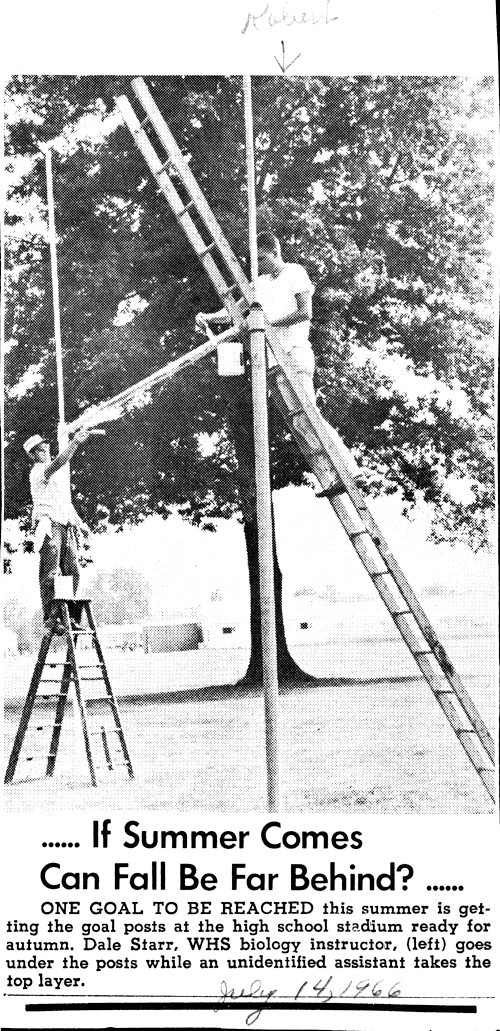
Summer Job 1966

As an undergraduate at Ohio State, I worked during the summer months on the maintenance crew for the Westerville (Ohio) Board of Education.  Most often I was a painter, at one point even being put in charge of my own paint crew(!).  The photo below was cut out of the local weekly newspaper, the Westerville Public Opinion.  That's my mother's handwriting identifying me (top) and the publication date (bottom).  The photo shows Westerville (South) High biology teacher (and my former basketball coach), Dale Starr (left), and me (center) painting a goal post at the high school football stadium.  Luckily, there are no photos of our next job, which was to paint the rusting chain link fence around the field using long-nap rollers.  Both Dale and I went home at the end of each day caked with aluminum paint, thanks to a strong breeze that blew silvery mist all over us as we rolled our way around the field.

April 28, 2013

USC Annual Staff Retirement Recognition Luncheon 2013

Three USC retirees chatting before the Staff Retirement Recognition Luncheon in Town and Gown, 21 March 2013.  From the left: Howard Saperston (seated), Richard Martin and me (standing).  Photo by Art Ochoa.

April 13, 2013

Our Visit to KUSC Classical FM 91.5

On April 3, 2013, Alex and I were given a tour of USC's classical FM radio station, KUSC, whose studios are located in the AT&T building at 1149 South Hill Street in downtown Los Angeles. Our host was Eric DeWeese, General Manager of KUSC.  While there, we met and chatted with on-air morning hosts Dennis Bartel and Alan Chapman.  Here is Mr. Bartel's famous description of the KUSC studios:

"Broadcasting from the bottom of . . ."

". . . the glass-top building . . .

". . . in the shadow of the great arena."

March 20, 2013

Wesley Eugene Bjur


My former office mate at USC, now deceased, as is his wife of 65 years, Dottie, who preceded him in death by five months.

December 27, 2012

Terry, Dave, and Bob

My sister-in-law, Kalenn, and my brother, Dave, came across this photo, had it enlarged, and sent it to me (framed) as a Christmas present.  It must have been taken in 1957 or 1958 and is the only picture that I have of our pet miniature collie, Terry.  Dave is on the tricycle (right), and that's me in the center.  We are in the backyard of the house where we grew up on North Vine Street in Westerville, Ohio.  In the background (left) is the "clubhouse," a shed that my father bought from our next door neighbor, Harry Dimmerling, and single-handedly moved to its new concrete block foundation which he built himself.  The photo was taken before the two-car garage was built in the space behind us.  Many thanks to Kalenn and Dave for the photo!

December 9, 2012

A Brief Reflection on My Offices at USC

When I arrived at USC in the fall of 1975 as an assistant professor in what was then called the School of Public Administration (SPA), I was assigned an office on the third floor of the Washington Building (below) at 311 South Spring Street in downtown Los Angeles.  (If you watch N.C.I.S., you may have seen this building in

the background near the end of the October 21, 2008, Season 6 episode titled "Nine Lives" when Gibbs and Fornell drive to the courthouse [actually the Ronald Reagan State Office Building across the street at 300 South Spring] to try to prevent Sgt. Jack Kale from killing mobster Rick Azari.  This was SPA's Civic Center Campus at the time from which it offered Master's-level courses to people working in local government and law enforcement (the latter pursuing advanced degrees with funds provided under the Law Enforcement Education Program, or LEEP.  In addition to teaching duties, technically I was the "Research Director" of USC's Institute for Disaster Preparedness (IDP) that offered graduate courses to local emergency services coordinators receiving tuition from the Defense Civil Preparedness Agency and that provided workshops and training for professionals in the emergency services field.  The institute itself did not conduct sponsored research, but the graduate course format (once-a-week evening classes and "intensives," meaning all-day sessions that ran Thursday through Sunday twice each semester) made it possible for me to write and publish my own research.  One of the nicer aspects of being on South Spring Street was being just around the corner from the famous Bradbury Building in the 300 block of South Broadway.

At that time there was a small restaurant on the second floor of the Bradbury Building that served excellent chili for lunch. Across the street from the Bradbury Building is Grand Central Market, not only an open-air market but an early food court as well.

I was only at the Civic Center Campus for one academic year.  A colleague whom I did not know at the time named Lou Weschler persuaded the acting dean, John Kirlin, that an untenured assistant professor should not be so isolated from his colleagues.  So, despite the objections of the IDP Director, Larry Snell, I was relocated to what we used to call the "main campus" for Fall Semester 1976.  (Over the years, our colleagues at what is now the Keck School of Medicine of USC had long complained about the terms "main campus" and "medical campus," so, to reduce the connotation of second tier status, the terms "University Park Campus" [or UPC] and "Health Sciences Campus" [shortened to HSC] were introduced and have been used ever since.)  The office that I moved into was a single-person, windowless office in the Von Kleinsmid Center (VKC; below) that I shared with

another new faculty arrival, the economist John Schunhoff.  After a year or so, John and I were relocated to a larger office—with windows—in the southeast corner of the third floor overlooking what is now called McCarthy Quad (then called Fagg Park named for USC's sixth president, Fred D. Fagg, Jr.).  When John tired of the "publish or perish" pressures of a research university and resigned to take a top administrative position with the Los Angeles County Department of Public Health, I was moved into another large office in the northeast corner of the third floor that I shared with Wesley Bjur.

After a few years, expansion of the dean's office in VKC claimed the office that Wes and I shared.  He and his wife, Dottie, decided to relocate to the school's Sacramento Public Affairs Center (SPAC), and I was offered the chance to have a private office in a strange pie-shaped structure on the corner of South Flower Street and Exposition Boulevard called the Tyler Building (below).  (This triangular building was actually surrounded on all sides by streets, including Figueroa Street on the west and 37th Street on the south with an unused [at the time] railroad track on the other side of the outer wall of my office between the building and Exposition Boulevard.)  The economist Don Winkler, now retired and making wine in South Africa, was instrumental in persuading me to make the move.  [The Tyler Building was named after Farmers Insurance Group co-founder John C. Tyler who also gave money to USC to establish the Tyler Prize for Environmental Achievement.]

My Tyler Building office, which lacked windows, was spacious, the largest private office I had at the university.  My five faculty colleagues and I became very close as we shared space in this just off-campus, slightly out-of-the-way office building.  The main downside was having to cross both Exposition Boulevard and Figueroa Street several times a day going to and from class, lunch at the Faculty Center (now University Club), the bus stop on Figueroa, etc.  (During the time I had an office in the Tyler Building, a USC female staff member was struck and killed in the crosswalk at the intersection of Exposition Boulevard and Flower Street just outside the building.)  Also housed in the Tyler Building were the Delinquency Control Institute (DCI), which provided training for law enforcement officers newly assigned to juvenile divisions, and L. A. Semester, a program for undergraduates that gave them hands-on experience in public agencies.  The L. A. Semester offices were down the hall from my office, and passing my open door every day was one of the administrators of the program, David Raksin.  Raksin was a composer who wrote for film and television and is probably best known for having written the theme song for the 1944 movie, Laura, starring Gene Tierney and Dana Andrews.  David was a nice guy; it wasn't until much later that I learned about his "real" job.

Over time, as people left for new positions (Winkler to the World Bank where he would recruit Gary Reid shortly afterward; Joan Krueger, who followed her husband, Brian Betker, when he finished his Ph.D. at UCLA and took a faculty position in the Midwest; Rich Sundeen, who became Assistant Dean in charge of the school's undergraduate programs and thus had to move back to "headquarters"), I was persuaded by then dean Ross Clayton that the Tyler faculty were too remote from students and agreed to move back to VKC.  This time, I was given a private office (with windows) in a newly constructed suite with four faculty colleagues once again on the third floor.  This office was about one-fourth the size of the one that I gave up in the Tyler Building, but it was near the center of campus and its west-facing windows overlooked the (sunken) VKC courtyard (below) and carillon tower with the distinctive finial on top.  (In those days, the carillon sounded on the quarter hour and actually played music at noon as classes changed.)  Only recently did I discover some of the history behind the tower and its finial.

My final stop was the newly-constructed Ralph and Goldy Lewis Hall (RGL; below), home for the equally new School of Policy, Planning, and Development, an unhappy "merger" of sorts between the SPA, the School of Urban and Regional Planning, and the Lusk Center for Real Estate (from what is now the Marshall School of Business) as well as a few other smaller entities.  I was assigned a nice

corner office (RGL 200) with a north-facing window looking out on Childs Way and the rear of Doheny Memorial Library.  I later found out that the former dean of the planning school, Ed Blakely, had wanted this office because it was next to the stairway at the south end of the hall. He told me he had wanted that office so that he could come and go without being noticed.  I was given the office instead since it was well known that Ed was leaving USC to return to the Bay Area in order to run (unsuccessfully, as it turned out) for mayor of Oakland.  When the school's development staff spilled out of the suite across the hall to claim my office, I was moved to the opposite end of the hallway.  This would be my final office as a USC faculty member.  It was notable for two things: its north-facing window looked out onto Widney Alumni House, and it was adjacent to the office assigned to Kevin Starr, who never used it because he was in Sacramento serving as the California State Librarian and continuing to write about the history of California.  I never had a chance to meet Kevin, but, through a mutual friend and colleague, James Moore II, I was able to secure his autograph on one of his books which I was reading at the time.

ADDENDUM:  Walking down the second floor corridor in RGL Monday morning (10 December 2012), I spotted this sign on the wall across from my second and final office.  Apparently the Schwarzenegger Institute is being housed in RGL until its permanent home in the new Verna and Peter Dauterive Hall (under construction next door on the former sites of the RGL patio and the University Club) is completed.